
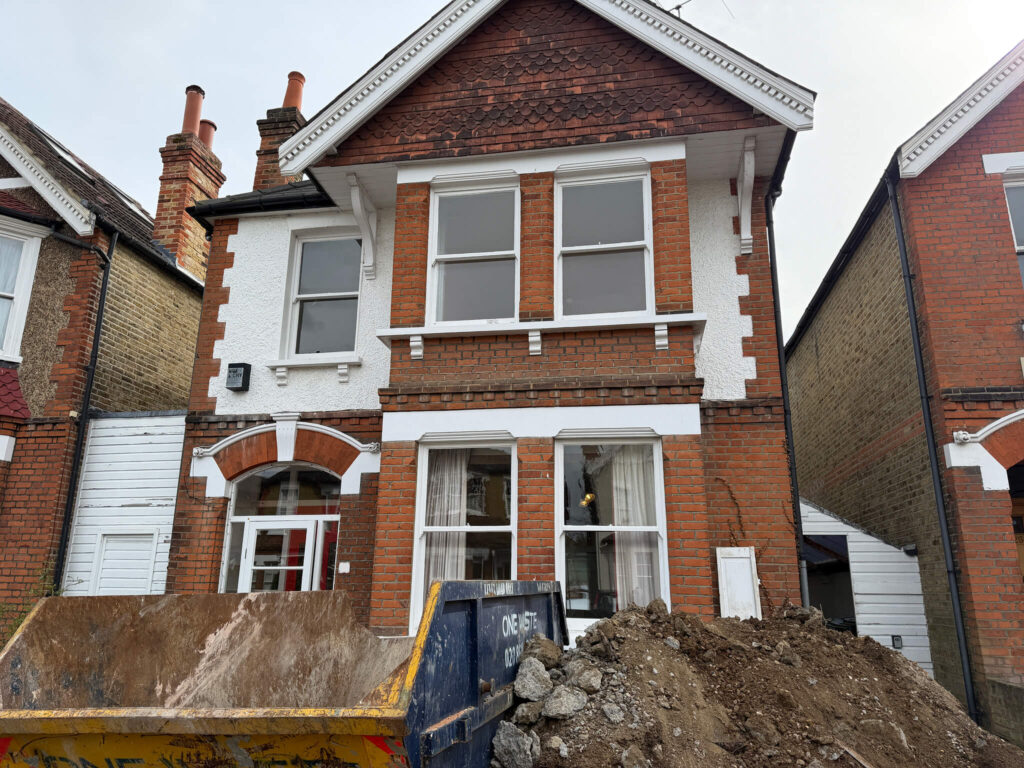
If you have had a quote to replace your original box sash windows, the number probably came as a shock.
Bespoke timber units run £1,500 to £2,500 each and on a standard Victorian terrace with twelve windows, you are looking at £18,000 to £30,000 before scaffolding, making good, or repainting even enters the picture.
Here is the thing most installers will not tell you: in the vast majority of cases, that work is not needed.
The original sash window box frame the structural part set into the wall almost never fails. What actually needs sorting is the glazing, the draught seals, and the timber on the sashes themselves.
All of that can be done at a fraction of the cost.
This guide covers every sash window cost in 2026 full replacement, partial repairs, and the retrofit option that most homeowners do not know exists.
Sash window cost calculator
Compare full replacement costs against our restoration and vacuum glazing retrofit.
Replacement
—
SJ Retrofit
—
You save
—
Step 1 of 5
How many sash windows do you have?
If you have a bay window, count each sash window individually.
Of these, how many are larger or more complex?
Large and extra-large windows cost more to manufacture.
Large Victorian
850×1,800mm · +15–20%
Extra Large / Georgian
1,000mm+ wide · +30–40%
Step 2 of 5
What type of property?
Sets scaffolding requirements and regional labour rates.
Region
Planning status
Listed building: LBC professional fees (heritage statement + architect drawings) typically add £2,500–£7,000 before any windows are ordered — with no guarantee of approval.
Step 3 of 5
Frame material
Which frame material are you considering?
Step 4 of 5
Glazing specification
Glazing is the biggest driver of thermal performance.
Step 5 of 5
Sash mechanism
Affects upfront cost and long-term servicing.
Your estimate
Cost comparison
Based on your selections
Full Replacement
—
—
Total project estimate
Scott James Retrofit
Restoration + Vacuum Glazing + Draught-proofing
—
No scaffolding needed in 90% of cases
- ✓Full timber repair with Tricoya lamination
- ✓LandVac vacuum glazing — 0.4 W/m²K
- ✓Comprehensive draught-proofing throughout
- ✓New cords, serviced pulleys & new locks
Want a more accurate estimate?
Every property is different. Send us a few photos or your address and we’ll give you a detailed estimate tailored to your windows.
Typical sash windows issues that homeowners want to resolve with looking for replacement windows
Original sash windows were built to last and to be maintained across generations. Replacement feels like the obvious fix our brains want to solve all the problems at once and start fresh but new does not always mean better than old.
| Symptom | Likely Cause | Typical Solution |
|---|---|---|
| Rattling, draughts, or cold air around the frame | Worn or absent draught seals | Draught-proofing |
| Window will not open, or opens with difficulty | Paint build-up, swollen timber, or broken cord | Overhaul and cord replacement |
| Sash drops or will not stay open | Broken sash cord or failed spring balance | Cord or balance replacement |
| Rot on the sill, bottom rail, or sash | Timber decay from water ingress | Timber restoration |
| Condensation between panes of glass | Failed sealed unit | Glazing unit replacement |
| Single glazing — cold, noisy, condensation on the glass | No insulating glazing | Vacuum glazing retrofit |
| Structural rot in the main box frame built into the wall | Severe, long-standing decay | Full window replacement |
In most cases the issues homeowners face with sash windows can be solved through restoration.
And by upgrading the single glazing to vacuum insulated glazing, the windows become as thermally efficient as a modern high-end replacement.
Even where the box frame has suffered rot, it can in most cases be repaired back to its original condition rather than replaced entirely.
How much do new sash windows cost to replace, and what are the options?
The tables below cover every sash window replacement option available, split between full replacement in different frame materials, as well as the cost of the alternative to replacement - restoration and glazing upgrade.
1. Cost of new double glazed wooden sash windows
Prices are UK averages for 2026. London and the South East carry a 20–30% premium. Scaffolding, making good, and redecoration are not included in full replacement costs.
| Option | Typical cost per window | What is included? |
|---|---|---|
| Timber replacement (Softwood) | £1,500 – £1,800 | New bespoke softwood unit and box frame, standard glazing |
| Timber replacement (Hardwood) | £1,800 – £2,200 | New bespoke hardwood unit and box frame, standard glazing |
| Timber replacement (Accoya / High-end) | £2,500+ | New Accoya unit and box frame, premium glazing / VIG |
Fully installed softwood replacement windows start at around £1,500 each. Hardwood options like oak, Accoya, and iroko cost more than £2,500 per window due to significantly higher material costs.
A typical Victorian terrace with twelve windows would need £18,000 to £30,000 for like-for-like timber replacement and that figure does not include any of the associated building work.
Options for timber-frame sash window replacements
Window sizes, styles, and glazing bar configurations
The two most obvious cost drivers for any sash window are its size and its architectural style.
A larger window requires more timber, heavier glass, and larger counterweights all of which increase both material and labour costs.
The second factor is architectural complexity: a straightforward Victorian sash with a simple 1-over-1 or 2-over-2 pane configuration is significantly cheaper to manufacture than a Georgian window with its intricate six-over-six glazing bar arrangement, which demands far more precision joinery and skilled labour.
The table below illustrates how size and style affect the cost relative to a standard Victorian window as the baseline.
| Window Style | Typical Dimensions (W x H) | Glazing Configuration | Price Premium vs Baseline |
|---|---|---|---|
| Victorian (Standard) | 700mm x 1,500mm | 1-over-1 or 2-over-2 | Baseline |
| Victorian (Large) | 850mm x 1,800mm | 1-over-1 or 2-over-2 | +15% to +20% |
| Victorian (Extra Large) | 1,000mm x 2,000mm | 1-over-1 or 2-over-2 | +30% to +40% |
| Georgian (Standard) | 900mm x 1,700mm | 6-over-6 | +10% to +15% |
| Georgian (Large) | 1,000mm x 2,000mm | 6-over-6 | +25% to +35% |
| Georgian (Extra Large) | 1,000mm x 2,400mm | 8-over-8 or larger | +45% to +55% |
Special shape windows (arched and curved)
While standard rectangular box sash windows are relatively straightforward to manufacture, any deviation from straight lines introduces significant complexity and cost.
Shaped heads - such as true arches, swept heads, or gothic arches - require highly skilled bespoke joinery.
Unlike straight timber sections which can be machined efficiently, curved timber frames and sashes must be carefully laminated or cut from much larger blocks of premium timber to maintain structural integrity without the grain splitting.
The glass must also be custom-cut to a template, and the internal mechanisms often have to be specially adapted to fit within the restricted upper frame.
Because of this intense manual labour and material waste, you should expect a substantial premium for any shaped window:
- Swept head (subtle curve): Typically adds £200 to £300 to the base cost of the window.
- True arch (full semi-circle): Typically adds £400 to £600+ to the base cost of the window.
For highly bespoke shapes like circular or oval pivot windows, the cost is entirely custom and can easily exceed £3,000 per unit.
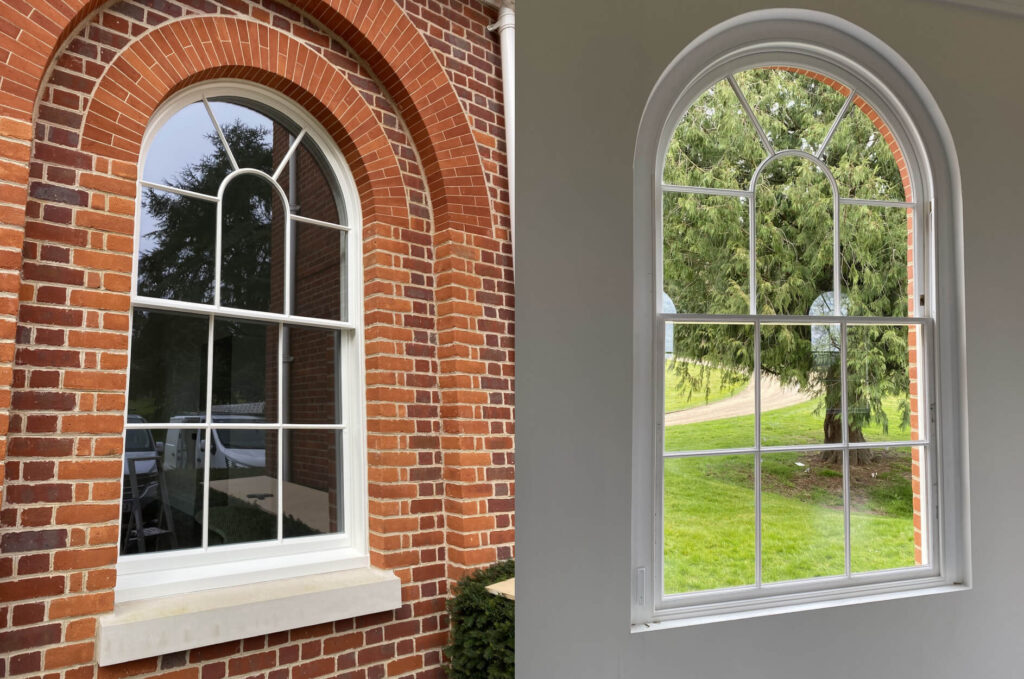
The most economical method to handle original arched sash windows is to restore the existing curved frames and retrofit new sashes - this avoids the substantial premium of manufacturing new curved joinery from scratch.
Pulleys and weights vs. spring balances
The balance mechanism affects both the installation cost and what you will spend on maintenance over the years.
Traditional weight and pulley systems are significantly more expensive to manufacture and install, often adding £200 to £400 per window compared to modern spring balances.
Spring balances are cheaper and faster to install, but they do not offer the authentic heritage feel or the same smooth, durable operation as traditional weights.
Servicing costs and maintenance requirements
A traditional weight and pulley system is incredibly simple and robust. When a cord eventually snaps - typically after 15 to 20 years - a professional sash cord replacement generally costs between £150 and £280 per window.
Spring balances lose their tension over time and the internal mechanisms can fail entirely.
Replacing broken spring balances requires specialist parts - specifically matching the exact tube diameter, length, and weight-bearing capacity of the original manufacturer.
Professional spring balance replacement typically costs £180 to £350 per window, making the cheaper initial option more expensive and frustrating to maintain over the lifetime of the window.
Timber choice: Softwood, Hardwood and Accoya
Softwood (usually whitewood) is the cheapest option, starting at around £1,500 per window, but it needs repainting every five to seven years and rots quickly if maintenance slips.
Hardwood species and modified timbers like Accoya sit 60–70% above standard rates, with windows typically costing £2,500 or more.
The premium is justified in practice: Accoya carries a 50-year rot-proof warranty, barely moves in wet weather, and holds paint three times longer than softwood which means substantially lower maintenance costs over the life of the window.
2. Cost of new uPVC and Aluminium sash windows
| Option | Typical cost per window | What is included? |
|---|---|---|
| uPVC sash window | £1,000 – £2,800+ | New uPVC unit and frame, standard double glazing; low-end budget to high-end heritage spec |
| Aluminium sash window | £1,200 – £1,800 | New aluminium unit and frame, standard double glazing |
3. The retrofit package (restoration + glazing upgrade)
The restoration and glazing upgrade package is the core service we offer at Scott James Windows.
We restore your original frames rather than replacing them and upgrade the glazing from single to vacuum insulated, achieving A-rated thermal performance. We can reglaze both, sash and casement windows.
| Option | Typical cost per window | What is included? |
|---|---|---|
| Restoration + vacuum double glazing + draught-proofing | £1,100 – £1,300 | Full timber repair, VIG units retrofitted into original sashes, comprehensive draught-proofing |
4. Localised box sash window repairs
| Option | Typical cost per window | What is included? |
|---|---|---|
| Draught-proofing only | £280 – £500 | Purpose-made perimeter seals fitted to existing sashes |
| Basic overhaul and draught-proofing | £350 – £650 | Cord replacement, pulley service, basic draught-proofing |
| Full restoration (no glazing upgrade) | £650 – £1,200 | Timber repairs, draught-proofing, mechanism overhaul |
| Secondary glazing | £400 – £900 | Secondary frame fitted internally over existing window |
| Restoration + vacuum double glazing + draught-proofing | £1,100 – £1,300 | Full timber repair, VIG units retrofitted into original sashes and draught-proofing |
What does a whole-house project cost?
Per-window prices are useful, but most people want to know what the whole job will cost. The table below shows typical totals for common UK property types.
| Property type | Windows | Full timber replacement (incl. hidden costs) | Restoration + VIG retrofit |
|---|---|---|---|
| Ground-floor flat | 3–4 | £6,500 – £12,000 | £3,300 – £5,200 |
| 2-bed terraced house | 6–8 | £12,000 – £22,000 | £6,600 – £10,400 |
| Victorian terraced house | 10–12 | £20,000 – £35,000 | £11,000 – £15,600 |
| 3-storey townhouse | 14–18 | £28,000 – £50,000+ | £15,400 – £23,400 |
The retrofit column excludes scaffolding because in 90% of cases it simply is not needed.
The replacement column includes a realistic allowance for scaffolding and making good — costs that are rarely mentioned upfront but always show up in the final bill.
Glazing options: Standard insulated glazing vs vacuum insulated glazing (VIG)
Choosing the right glazing should be your top priority, but most homeowners barely give it any thought.
People typically get caught up in deciding between timber, uPVC, or aluminium frames but after installation, the frame itself does not do much of the heavy lifting.
It is the glazing unit that controls room temperature, determines how much outside noise gets in, affects whether you will see condensation on the glass, and ultimately shapes what you will pay for heating over the next twenty years.
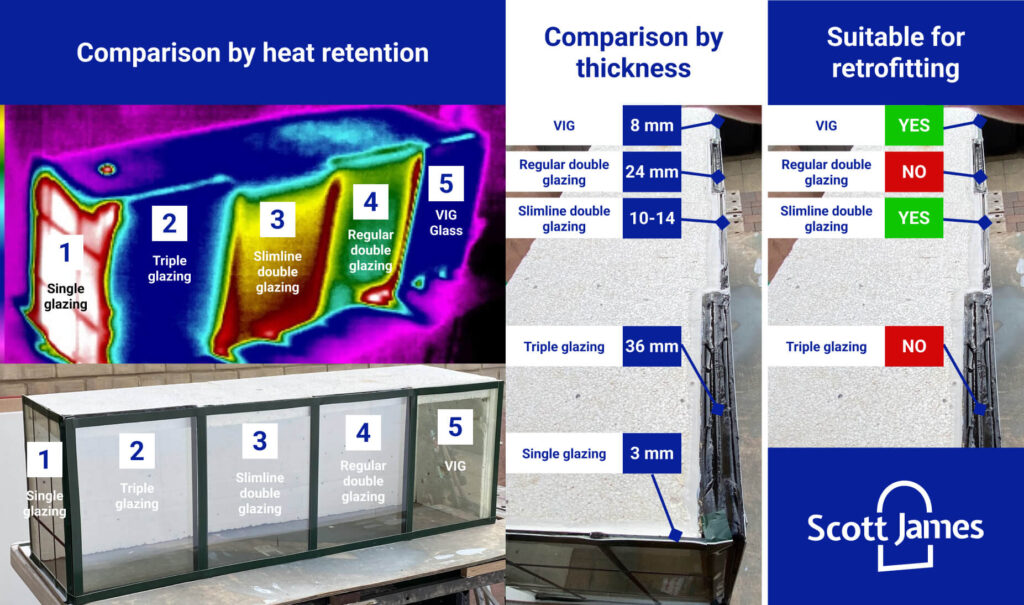
Gas-filled double glazing is currently the industry default
Almost all new replacement timber windows come fitted with standard, low-e laminated glass and gas-filled cavity. Standard double-glazed units cost between £80 and £120 per square metre for trade because UK manufacturers produce them at an affordable price point.
VIG is Scott James’ default option
At Scott James Windows, we use VIG glazing as the default option.
With other companies, opting for VIG instead of conventional double glazing usually comes with a higher upfront cost - typically £200 to £400 more per window - but it offers several advantages that make it better value over the long term.
In terms of thermal performance, VIG achieves a U-value of 0.4–0.7 W/m²K it made of toughened glass, depending on the product, which equals or surpasses triple glazing, whereas conventional double glazing typically sits between 1.1 and 1.4 W/m²K.
uPVC sash window prices
uPVC is the most commonly quoted replacement option because it is cheaper to manufacture than timber. All prices below are for a standard Victorian sash window (approx. 1,200mm × 1,200mm), fully installed.
Basic double glazed uPVC sash windows
Budget uPVC sash windows feature smooth white plastic frames, welded mitre joints which leave a visible diagonal mark at the corners, clip-on sash horns, and standard double glazing. Supply-only units cost £500–£700, but professional installation removing the original box frame and making good brings the true cost to around £1,000.
The frames are inherently thicker than original timber, reducing the glazed area and altering the window's proportions.
Plastic material undergoes deterioration with extended UV exposure, losing colour and becoming brittle over time.
Woodgrain foil and Georgian bar options are available, but the underlying thick frame profile does not change.
Better quality uPVC sash window
A small number of specialist manufacturers produce heritage-grade uPVC systems with mechanical butt joints, deep bottom rails, putty-line external profiles, and slimline frames that more closely match original sightlines.
These products offer far better value than budget alternatives.
Fully installed, they start around £1,500 and exceed £2,000 with custom colours, woodgrain finishes, or acoustic glass. At this price point, the cost often equals or exceeds a full timber restoration with vacuum glazing.
Planning restrictions
uPVC is strictly prohibited in Grade II listed buildings. In conservation areas, standard uPVC is routinely refused by planning officers; heritage-spec systems can sometimes secure approval but require detailed specification packs and are never guaranteed.
Restoring original frames is vastly preferred by planning authorities and avoids the application process entirely.
Hidden costs of full sash window replacement
Most installers quote supply and fitting only. Several significant costs are routinely left out.
Scaffolding requirements
The table prices shown above cover only the cost of new sash windows. Several additional expenses will almost certainly appear on your final invoice.
Scaffolding is the largest extra cost.
The Work at Height Regulations 2005 require safe working conditions for any replacement work above ground floor level.
For a typical two-storey terrace, full scaffolding runs between £800 and £1,500, and it needs to stay in place for the duration of the job usually two to three weeks.
For larger properties, scaffolding alone can reach £2,000 to £3,500. Below are typical hire costs for a standard 4-to-6-week period:
- 2-storey terraced house (front elevation only): £400 – £550.
- 3-storey Victorian townhouse (front elevation only): £600 – £800.
- 2-storey semi-detached house (3 sides): £750 – £1,150.
- 2-storey detached house (all 4 sides): £1,200 – £1,800+.
Note: If your property requires a "bridging scaffold" to safely span over a glass conservatory or lean-to extension, expect to add an additional £400–£500 to the costs above.
Making good
Taking out a sash box frame from the masonry leaves an unfinished opening that requires making good.
The surrounding brickwork or render will need attention, and you will almost certainly have to patch the interior plaster this can be extensive if the original frame was set into a deep reveal. On the outside, any render or pointing around the new frame needs to be repaired and painted to blend with the existing surface.
Patch repairs around replacement windows typically leave a visible mark against the surrounding wall, which often leads homeowners to repaint the entire elevation.
Plan for £300 to £800 per window for these finishing works, depending on the condition of the surrounding wall.
Costs vary based on the type of exterior surface:
- Standard cement render or pointing: Basic patching usually costs £150 – £300 per window.
- Specialist through-colour renders (e.g., K-Rend, silicone): These renders are notoriously difficult to patch seamlessly. A patch repair around a new window will almost always leave a visible mark. To achieve a uniform finish, the entire elevation often needs to be re-skimmed or re-coated, pushing costs from a few hundred pounds into the £1,000+ range.
- Heritage lime render: Repairing lime render around a window reveal typically costs £200 – £400 per window due to the specialist materials and labour required.
- External Wall Insulation (EWI): If your property has been retrofitted with EWI, full window replacement is highly complex, often adding £300 – £600 per window in specialist repair costs.
The original outer box frame remains completely undisturbed during restoration and retrofitting work, which eliminates all of these exterior repair expenses.
The alternative to replacement: cost of sash window restoration and glazing upgrade
A complete restoration and vacuum double-glazing retrofit from Scott James Windows costs £1,100 to £1,300 per window - 40 to 60 percent less than full bespoke timber replacement, with equivalent or better thermal performance.
Vacuum insulated glazing - no compromise on the most important part
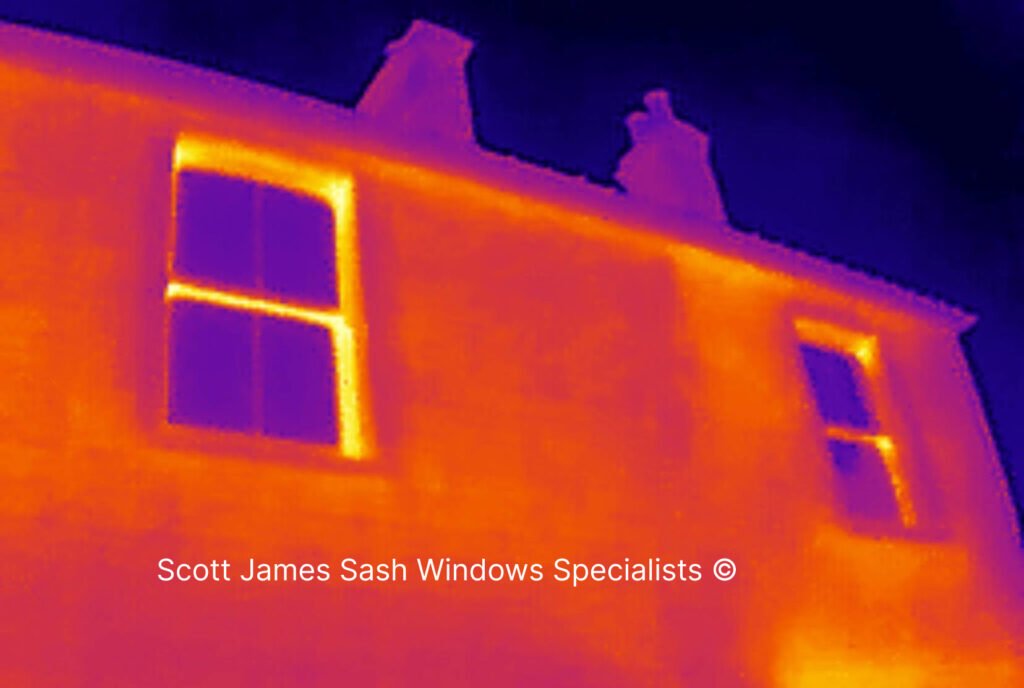
The restoration and reglazing package uses vacuum insulated glazing (VIG) not the cheap standard double glazing that most replacement windows default to.
VIG maintains its insulation performance through a microscopic vacuum space which produces a U-value that surpasses triple glazing while maintaining a thickness which resembles traditional single glazing. It is toughened as standard.
Timber frame restoration, draught-proofing, and functional repairs
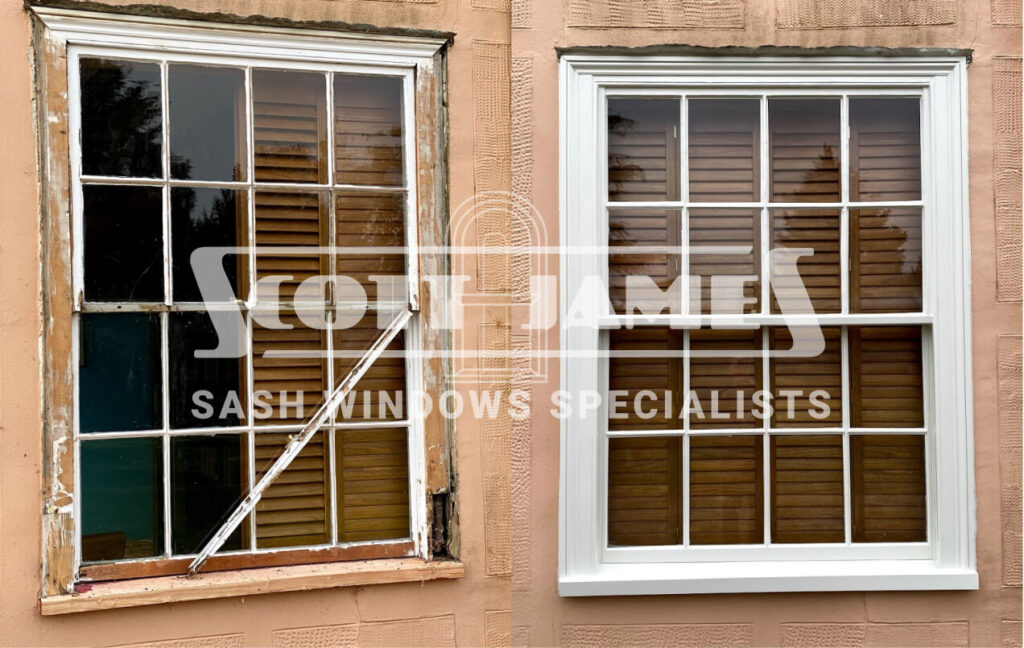
The refurbishment process focuses on external work: damaged areas receive permanent epoxy splice repairs before Tricoya wood laminates the entire frame to produce a continuous surface which becomes more durable than a basic splice repair alone.
Tricoya functions as the acetylated MDF equivalent of Accoya timber - the same acetylation process which provides Accoya with its outstanding dimensional stability and 50-year durability guarantee - meaning a Tricoya-laminated restored frame delivers performance levels which match those of a new window constructed from Accoya wood.
A complete sash window draught-proofing system is installed throughout, eliminating air infiltration- the primary source of heat loss in sash windows.
New sash cords are fitted, the pulleys are serviced, and new high-quality locks are installed.
Why retrofitting saves thousands in hidden costs
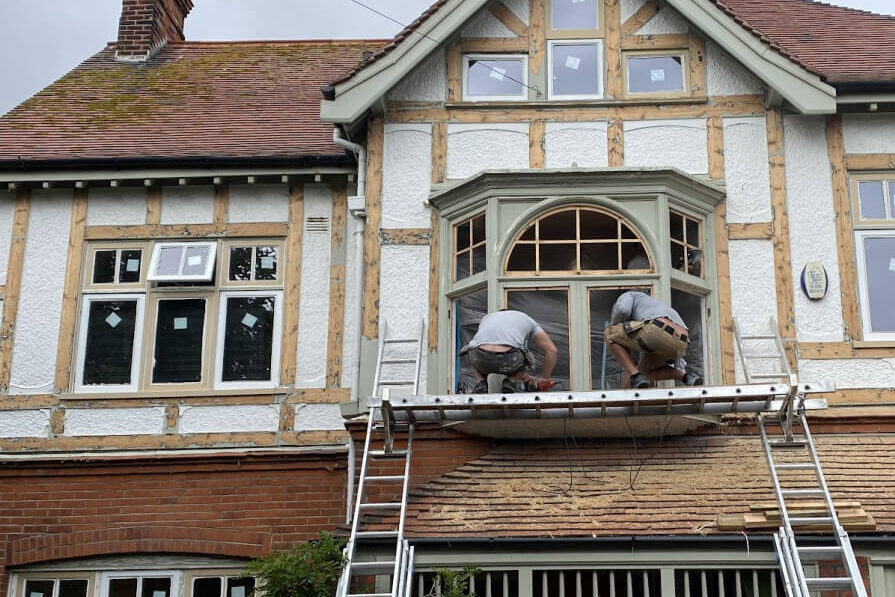
No scaffolding required in 90% of cases. Our glazing retrofit approach allows us to keep the main box frame intact. The process of removing sashes from inside the window allows us to work with our own access equipment without the need for expensive external scaffolding in 90% of cases.
No making good. The main box frame stays undamaged within the masonry, which protects all surrounding plaster surfaces, architraves, and exterior render from any harm. The property remains in its original condition except for improved window performance.
Get a free estimate for your property. Scott James Windows offers free, no-obligation estimates for restoration and vacuum glazing retrofits across London and the South East. Request your free estimate.
Sash window cost calculator
Compare full replacement costs against our restoration and vacuum glazing retrofit.
Replacement
—
SJ Retrofit
—
You save
—
Step 1 of 5
How many sash windows do you have?
If you have a bay window, count each sash window individually.
Of these, how many are larger or more complex?
Large and extra-large windows cost more to manufacture.
Large Victorian
850×1,800mm · +15–20%
Extra Large / Georgian
1,000mm+ wide · +30–40%
Step 2 of 5
What type of property?
Sets scaffolding requirements and regional labour rates.
Region
Planning status
Listed building: LBC professional fees (heritage statement + architect drawings) typically add £2,500–£7,000 before any windows are ordered — with no guarantee of approval.
Step 3 of 5
Frame material
Which frame material are you considering?
Step 4 of 5
Glazing specification
Glazing is the biggest driver of thermal performance.
Step 5 of 5
Sash mechanism
Affects upfront cost and long-term servicing.
Your estimate
Cost comparison
Based on your selections
Full Replacement
—
—
Total project estimate
Scott James Retrofit
Restoration + Vacuum Glazing + Draught-proofing
—
No scaffolding needed in 90% of cases
- ✓Full timber repair with Tricoya lamination
- ✓LandVac vacuum glazing — 0.4 W/m²K
- ✓Comprehensive draught-proofing throughout
- ✓New cords, serviced pulleys & new locks
Want a more accurate estimate?
Every property is different. Send us a few photos or your address and we'll give you a detailed estimate tailored to your windows.
Sash window costs for listed buildings and homes in conservation areas
For listed properties and homes in conservation areas, the window price is only part of what you will end up paying.
Planning fees, heritage consultant charges, and the premium for conservation-approved manufacturing all add up and none of them tend to appear in the initial quote.
The true cost of Listed Building Consent (LBC)
While the Listed Building Consent application itself is free to submit to the local authority, obtaining that consent for replacement windows is an expensive process. For a detailed guide to navigating this process, see our article on working with conservation officers. Conservation officers require detailed justification for removing original historic fabric.
If you are applying to replace your windows, you will typically need to pay for:
- Pre-application advice: £100 – £200 (charged by most councils to discuss feasibility before applying)
- Heritage / Design & Access Statement: £1,500 – £4,000 (a mandatory report prepared by a heritage consultant or conservation architect justifying the replacement)
- Conservation architect fees: £1,000 – £3,000+ (for producing the detailed 1:1 scale section drawings of the proposed new windows required by the council)
The administrative cost of simply asking to replace your windows can easily add £2,500 to £7,000 to your project with no guarantee of approval. The process typically takes 9 to 18 months from initial consultation to a decision.
The premium for heritage-matched replacement windows
If you do secure consent to replace windows in a listed building or strict conservation area, you cannot use standard off-the-shelf timber windows.
Conservation officers will mandate exact replicas of the originals. This requires bespoke joinery to match specific historical details, such as ultra-slim glazing bars, exact horn profiles, and traditional putty-line finishes.
Standard double glazing is almost universally refused on listed buildings. You will be required to specify either single glazing or specialist slimline or vacuum glazing.
Because of these strict manufacturing requirements, a conservation-approved bespoke timber replacement window typically costs £2,500 to £4,000+ per window roughly double the cost of a standard timber replacement.
The restoration and retrofit advantage for Heritage Buildings
Scott James's original sash window restoration and double glazing retrofit package cuts down significantly on these costs and complications, though it is important to have a clear picture of the regulatory requirements.
Historic England's guidance
Historic England's guidance, updated in July 2024, states that installing double or triple glazing into historic windows will usually require Listed Building Consent. This applies to vacuum glazing as well, even where the original frames are being retained. VIG is a material change to a listed building, and consent must be secured before any work begins.
The LBC application process is considerably simpler for a glazing retrofit than for full window replacement. Because the original box frames are kept and the external appearance of the property is unchanged, the application covers less ground — the conservation officer's assessment is focused on the glazing unit itself rather than the wholesale removal of original historic fabric.
We strongly recommend consulting your local authority conservation officer before starting any work. Pre-application advice typically costs £100–£200 and will clarify exactly what your property and local council require before you commit to any expenditure.
The Royal Borough of Kensington and Chelsea (RBKC)
There is one notable exception worth knowing about. The Royal Borough of Kensington and Chelsea (RBKC) has created a Local Listed Building Consent Order (LLBCO) that allows Grade II listed building owners in the borough to install vacuum glazing without submitting an individual LBC application, provided the replacement meets certain conditions - materials consistent with the building's character, and no change to frame dimensions or profiles.
If your property is in RBKC, check whether your project qualifies under this order before making a standard LBC application.
We hope other local authorities will follow RBKC's lead - it would make a real difference to listed building owners across the country who want to improve their homes' energy efficiency without unnecessary administrative cost.
Summary: the smartest way to spend your budget
Get a restoration specialist to assess your windows before agreeing to any quote for removing your original sash windows. The timber in your existing windows has probably lasted more than a hundred years. When properly repaired and fitted with the right glazing, it can easily serve another generation.
Full replacement only becomes necessary when the main box frame built into the wall has suffered severe structural decay. For everything else — rattling, draughts, windows painted shut, condensation, broken cords, rot on the sills — restoration and retrofitting is the right answer, not replacement.
Scott James Windows offers a complete retrofit package — full timber restoration, vacuum double glazing, and thorough draught-proofing — starting from £1,100 per window. Modern double-glazing performance, in your original frames, for less than half the cost of new windows.
Get a free estimate
Frequently asked questions
How much does sash window repair or restoration cost?
It depends on scope. Draught-proofing alone: £280–£500. Basic overhaul (cords, pulleys, draught-proofing): £350–£650. Full restoration with timber repairs: £650–£1,200. Full restoration plus vacuum glazing retrofit: £1,100–£1,300. All prices are per window.
Is it cheaper to repair or replace sash windows?
Yes, in almost every case. Full bespoke timber replacement starts at £1,500 per window and routinely exceeds £2,500 before scaffolding, making good, and redecoration. Restoration with vacuum glazing costs £1,100–£1,300 per window, requires no scaffolding in 90% of cases, and leaves the surrounding plaster and render completely undisturbed. Replacement is only necessary when the main box frame built into the wall has suffered catastrophic structural rot — which is rare.
Can you double glaze existing sash windows without replacing them?
Yes. Vacuum insulated glazing (VIG) is thin enough to retrofit directly into original sash frames with minimal rebate modification, achieving a U-value of 0.4–0.7 W/m²K depending on the product — matching or surpassing triple glazing — in a unit that looks like original single glazing. Standard slimline double-glazed units can also be retrofitted by deepening the rebate, but VIG delivers significantly better thermal performance.
How much does it cost to replace sash windows in London?
London and the South East carry a 20–30% labour premium. Full bespoke timber replacement that costs £1,800 per window elsewhere will typically cost £2,200–£2,500 in central London. A restoration and vacuum glazing retrofit runs £1,400–£1,500 per window in central London.
Do I need planning permission to replace sash windows?
In a conservation area, replacing windows with a different material or design requires planning permission. In a listed building, Listed Building Consent is required for any replacement — and also for retrofitting double glazing into original frames, even when the frames are retained (Historic England guidance, updated July 2024). The LBC application for a glazing retrofit is considerably more straightforward than one for full replacement. In unlisted conservation area properties, restoration that retains the original frames and external appearance is generally acceptable without a formal application — but always confirm with your local authority conservation officer.
How long do restored sash windows last?
Well-restored sash windows, with rot repaired using structural epoxy and Tricoya lamination, will last a further 25–30 years before requiring significant attention. Leading vacuum glazing products carry manufacturer warranties of 20–25 years, with a predicted service life of 60+ years. The original timber in many period properties has already lasted 100–150 years — when properly repaired, it is not the limiting factor.
Does draught-proofing attract VAT?
Draught-proofing is classified as an energy-saving improvement and currently attracts 0% VAT. All other restoration work — timber repairs, cord replacement, glazing — is subject to 20% VAT.